
The first sign of a ransomware attack is rarely dramatic. Perhaps there is a lag in the systems, or you experience files behaving strangely. You may notice a login that fails without a reason, and then things start locking up, such as access disappearing in pockets, then across teams.
At that point, it stops being an IT issue and becomes a business continuity event, where every minute counts.
Most organizations still talk about prevention as the main line of defense – firewalls, endpoint protection, awareness training – which is important. But when ransomware actually lands, the conversation changes to how fast you can recover, and how much of your business you can protect while doing it.
This is precisely where the idea of ransomware recovery infrastructure starts to feel like a necessity.
The Quiet Shift from Backup to Infrastructure Involvement
For a long time, recovery meant backups, where you stored data, hoped it was clean, and restored it when something went wrong.
Although theoretically simple, this is highly problematic in today’s environment: ransomware does more than encrypt files by moving laterally, targeting backups, and insidiously waiting before triggering damage.
Naturally, relying on disconnected backup systems feels dated, with recovery today depending on how your infrastructure is designed as a whole.
With platforms like Sangfor, this is already happening; compute, storage, and security are not isolated anymore, and share context. When something abnormal happens, the system does not wait for instructions. It reacts, isolates, and prepares recovery paths promptly.
Why Detection Is No Longer Separate from Recovery
Detection and recovery are not two separate steps but overlap almost always today. Recovery slows down when visibility isn’t clear, and teams hesitate because they do not know the scope of the attack.
The questions may be:
- Was it one workload or ten?
- Did it reach backup nodes?
- Are clean restore points even available?
Advanced tools like MDR Services and XDR step into this gap. They connect signals across endpoints, networks, and servers, forming a clear timeline of activity. This is not noise or isolated alerts, but a sequence. Instead of shutting everything down, teams can act precisely, isolate what is affected, and protect what is not.
How does detection directly impact recovery timelines?
Sangfor integrates detection layers like XDR into its infrastructure, which means identification and response happen in the same environment. This reduces the delay between discovering a threat and acting on it, allowing faster and more targeted recovery.
Resilience That Lives Inside the System
There is a noticeable difference between systems that react to failure and systems that expect it.
Modern ransomware recovery infrastructure is slowly moving into the second category, with snapshotting, immutable storage, and automated rollback, which are built into how systems operate daily. So, when ransomware tries to damage data, it is facing a system with a memory that already knows how to roll back to a pre-attack state.
Sangfor doesn’t rely on external tools, and its recovery processes exist within the same environment where workloads run. That cuts complexity in half, specifically during critical moments. Less complexity leads to faster recovery.
What makes Sangfor’s infrastructure approach future-ready?
Sangfor combines intelligent infrastructure with advanced detection models like MDR Services and XDR, allowing systems to adapt continuously. This reduces reliance on manual intervention and ensures faster, more predictable recovery as threats evolve.
A Glimpse into The Real World
It is easy to talk about architecture and capability, but actual experience tends to show up better in peer reviews.
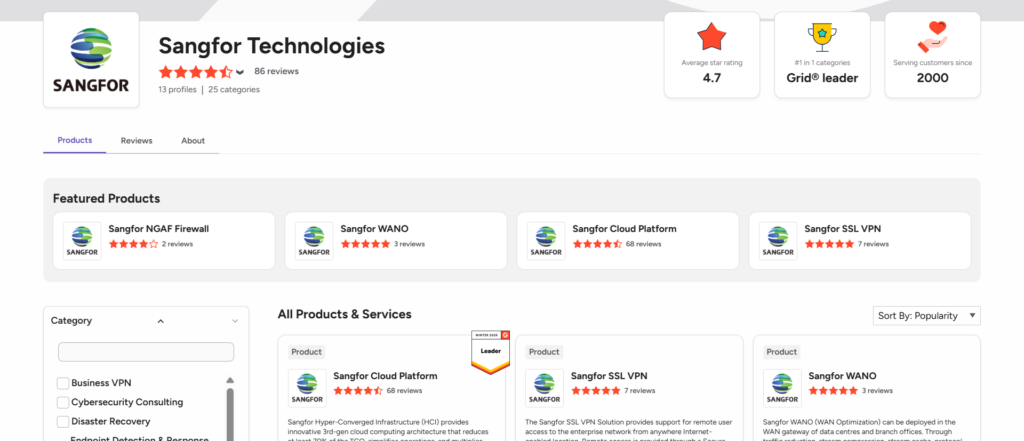
Date: May 14, 2026
Across platforms like Gartner and G2, users consistently highlight Sangfor’s offerings. The rating is 4.7 out of 5 on G2 and 4.8 out of 5 on Gartner, for hyper-converged infrastructure. This reflects strong confidence in real-world environments where downtime has tangible costs.
To drive home the point about Sangfor’s competency in this space, a relevant example would be Dana Pensiun Perkebunan (DAPENBUN), Indonesia, which adopted Sangfor MDR to manage rising cyber threats and alert overload within its IT environment. With 24/7 monitoring and faster incident response, the organization strengthened its ability to contain attacks early. This reduced operational impact and improved overall recovery readiness.
Where Things Fall Apart in Legacy Systems
Fragmentation is one of the primary causes for slow recovery. It is hard to communicate between separate tools for storage, backup, threat detection, and networking. During an attack, teams move between dashboards, trying to stitch information together, which takes too long. Even worse, decisions get delayed because no one has the full picture.
Modern ransomware recovery infrastructure removes that gap with a single control layer, shared intelligence, and coordinated response.
Why do legacy environments slow down ransomware recovery?
Sangfor addresses this by eliminating silos within infrastructure. In legacy setups, separate systems delay coordination. Sangfor’s unified environment allows detection, isolation, and recovery to happen within one platform, improving both speed and accuracy during critical incidents.
The Direction This Is Heading
Looking ahead, recovery is becoming predictive, where systems will prepare recovery paths continuously. Also, threat intelligence will feed directly into ransomware recovery infrastructure behavior, and AI-driven analysis will detect anomalies before they escalate. All recovery points will be validated in real time, not after an incident.
Sangfor combines infrastructure intelligence with detection frameworks like MDR Services and XDR to ensure fewer decisions and faster solutions during a crisis.